 Arnau Pont · Co-founder2026-04-21

Pay per Match?
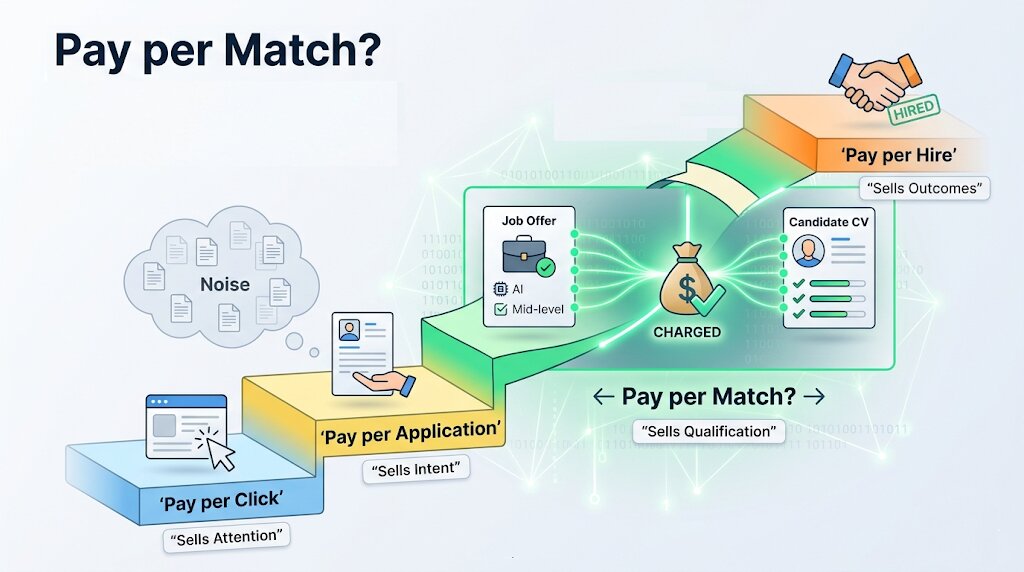
Pay per click is under pressure. Pay per application failed. Pay per hire is unmeasurable. What about pay per match?
The Pricing Ladder
Job board pricing has been climbing a ladder for the last two decades, trying to get closer to the thing the employer actually wants: a hire.
Pay per click was the first step. You pay when someone sees your listing. Simple, measurable, but completely disconnected from the outcome. The employer pays for attention, not results.
Pay per application was the next step. Indeed tried it. The idea was sound: charge only when a candidate actually submits an application. But the model created unexpected billing issues for smaller employers, and Indeed killed it by December 2023. With AI agents now generating applications at scale, the model would be even harder to sustain today.
Pay per hire is the dream. You only pay when someone actually gets hired. But nobody can measure it reliably. Some job boards try to track this through Disposition Data, asking candidates if they got the job or integrating with ATS to detect the hire. But ATS systems are fragmented, employers do not keep them updated, and there is no strong incentive for anyone to report the hire back to the job board.
There is a gap in this ladder. Between the application (which means nothing anymore) and the hire (which nobody can track). That gap might be the match.
What Is a Match?
A match is not a click. It is not an application. It is the moment when an algorithm determines that a specific candidate is genuinely qualified for a specific role, based on skills, experience, location, salary expectations, and whatever other signals are available.
The employer does not pay for someone seeing the listing. They do not pay for someone clicking apply. They pay for each candidate that the system has vetted against the job requirements. Not all matches will convert into hires, just like not all ad impressions convert into sales. But if you know that on average it takes 50 matches to close a role, you can price each match so the economics work. The perception is higher because every match has standalone value: a qualified profile the employer can evaluate.
This is not hypothetical. Companies at RecBuzz are already building the technology for this. Nobl.ai and Nejo offer AI matching affordable for mid-size boards. Genia AI adds a video interview layer on top of the match to collect extra context. Guhuza goes even further: the candidate never applies. The algorithm matches them first, and only then are they presented to the employer.
Why It Might Work
Pay per match sits in the sweet spot of the pricing ladder. It is closer to the outcome than pay per application, but it does not require tracking the actual hire.
It solves the application flood problem. If the employer pays for matches, not applications, it does not matter how many AI-generated applications arrive. The job board filters the noise internally and only charges for the signal.
It aligns incentives. The job board is incentivized to improve its matching algorithm, because better matches mean more revenue. The employer is incentivized to provide accurate job descriptions, because vague descriptions produce bad matches. The candidate benefits because they only get surfaced for roles that actually fit.
And it changes the candidate experience. If the job board does the matching, the candidate does not need to scroll, filter, and apply to dozens of listings. The experience starts to feel less like a job board and more like a headhunter reaching out with a role tailored for you.
What This Unlocks
It also creates a new kind of transparency. The job board can show the employer upfront how many potential matches their audience has for a given job ad, before they even publish it. This turns the job board into a consultative partner, not just a distribution channel.
There is an important distinction here between two types of matching. The first is matching people who apply to a job. The second is proactively matching candidates from the job board's audience and sending them the opportunity directly. The second type is far more powerful because the candidate cannot optimize their profile for a specific job offer. They do not know which jobs will be matched to them. This eliminates the growing problem of CVs tailored to fool matching algorithms. The candidate's best strategy becomes honesty.
This also opens the door to new dynamics on the candidate side. The job board can show candidates how attractive their profile is for current employers and for the market in general. It can suggest next steps: which skills are missing, how many more years of experience would unlock the next salary bracket, or which certifications would make their profile more appealing. The job board stops being a place where you search for jobs and becomes a place that tells you where you stand and what to do next.
Making It Work
The hardest part is defining what counts as a good match. A candidate might have the right skills but the wrong salary expectations. Or the right experience but in the wrong industry. The algorithm needs enough signal from both sides. But this is a quality problem, not a structural one, and it improves with data over time.
The model also has natural self-correcting mechanisms. The employer needs the hire. If they reject good matches, they do not fill the position. They hurt themselves. And the job board has data. If an employer systematically rejects matches that similar employers accept for similar roles, the pattern is detectable.
Job boards can design engagement flows that make the process transparent and improve the algorithm at the same time. Show one strong match upfront, then offer more: here are 5 additional candidates, unlock them one by one by providing short feedback on whether the match was relevant and why. The employer actively participates in improving the quality of future matches. And if the first match is great, the hiring manager wants more. What if the next one is even better? The dynamic becomes addictive. Not less matches, more.
Not every candidate in the job board's audience is actively looking for a job. But the match itself has value regardless. A qualified profile surfaced to the right employer is worth paying for, even if the candidate does not end up switching. The employer gets market intelligence: who is out there, what they look like, and how competitive the talent pool is.
Existing job boards are well positioned to test this. They already have the employers, the candidates, and the data. They can run experiments with pay per match alongside their current model and measure the results before fully committing. The transition does not have to be a leap of faith.
The Headhunter Parallel
There is a reason headhunters charge 20-30% of first-year salary. They do not sell visibility. They do not sell applications. They sell matches. A headhunter finds someone who fits, introduces them, and gets paid when it works.
Pay per match is essentially what headhunters have always done, but at scale and at a fraction of the cost. The job board becomes the headhunter. The algorithm replaces the recruiter's judgment. The match replaces the introduction.
The question is whether AI can match the quality of a good headhunter's judgment. Not yet for every role. But the gap is closing fast, and for roles where the matching criteria are more standardized, it might already be good enough. The rest is a matter of data and iteration.
Vertical and regional job boards can do this better for specific industries, geographies, and audiences where they have deeper data and stronger relationships. The opportunity is not to compete with generalist platforms. It is to offer better matches in the niches where generalists cannot go deep enough.
The Missing Step
The pricing ladder has a gap. Pay per click sells attention. Pay per application sells intent. Pay per hire sells outcomes. Pay per match sells qualification. It is the missing step that sits right where the technology is heading.
Job boards that figure out matching well enough to charge for it will have something rare: a pricing model that improves with AI instead of being destroyed by it.