 Arnau Pont · Co-founder


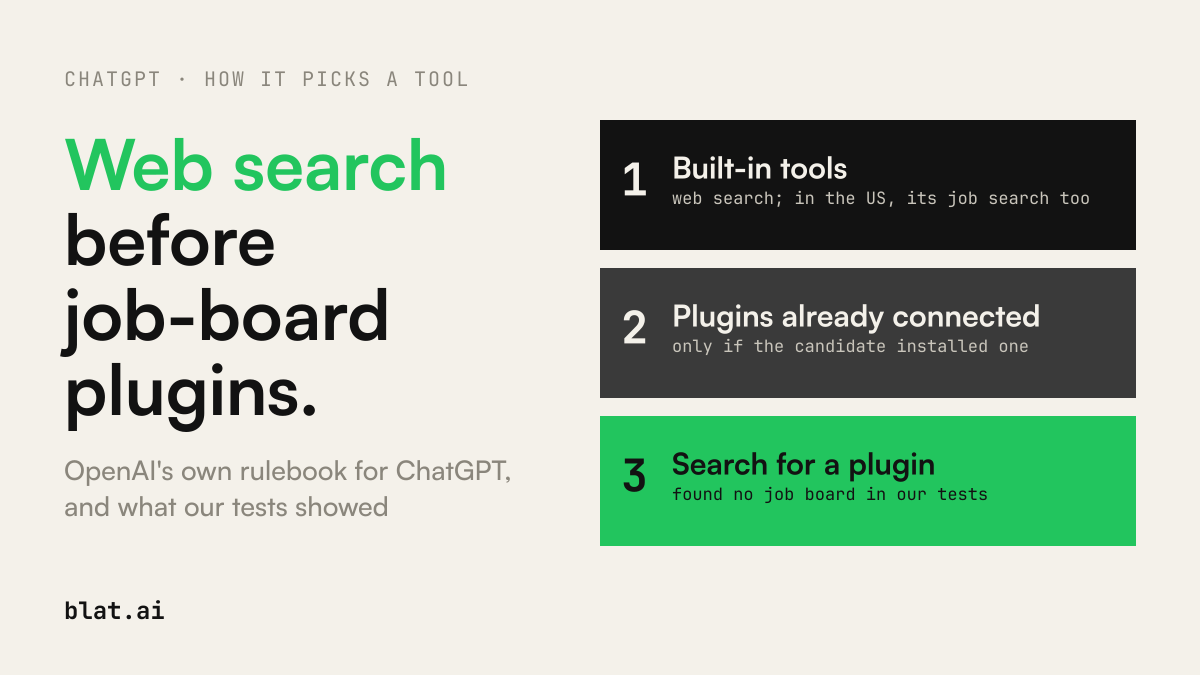
ChatGPT has a rulebook for plugins, and it puts web search before job boards' plugins. Before it reaches for a plugin, it uses its built-in tools, such as web search and, in the US, its own job search. Then the plugins the user has already connected. Only then does it search its catalogue, and in the signed-in chats, where we could read it, that search never returned a job board.
Indeed, ZipRecruiter, HelloWork, Naukri and InfoJobs Brasil have built their own ChatGPT plugins (part 1 called them apps; ChatGPT now calls them plugins). To see when ChatGPT uses them, we asked it for a job signed out, 30 times from Paris and 29 from Virginia; then signed in, with and without the boards' plugins connected. What we saw mostly follows the order of the rules.
The rulebook
OpenAI ships a plugin called Plugin Management, installed by default. It comes with a skill, a short set of instructions ChatGPT can load when it handles plugins. On the web, its page opens without an account. Reading the skill's text needs a sign-in: in the mobile app, side bar → Explore → Plugins → Plugin Management.
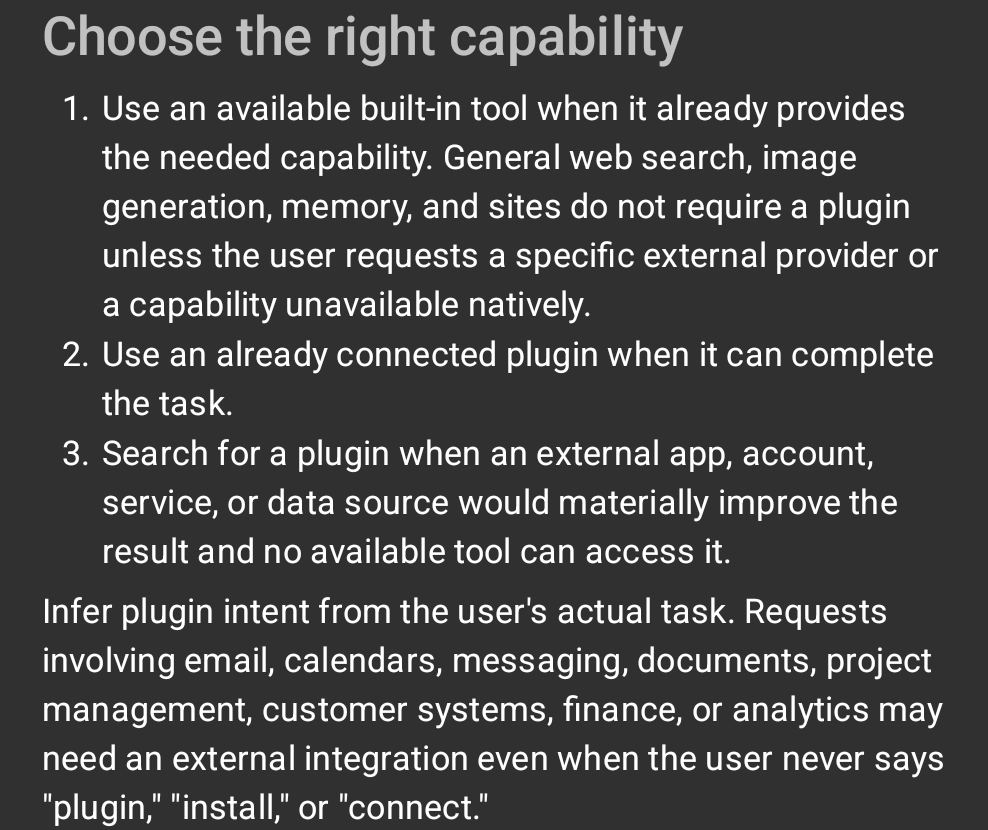
It tells ChatGPT to "choose the most direct capability for the user's task before searching for anything new", in this order:
- Use an available built-in tool when it already provides the needed capability. General web search, image generation, memory, and sites do not require a plugin unless the user requests a specific external provider or a capability unavailable natively.
- Use an already connected plugin when it can complete the task.
- Search for a plugin when an external app, account, service, or data source would materially improve the result and no available tool can access it.
Then it lists the kind of request that "may need an external integration even when the user never says 'plugin'": email, calendars, messaging, documents, project management, customer systems, finance and analytics. Jobs aren't on the list.
For a job board, that order matters. A job search is something web search can already do, so under rule 1 it doesn't need a plugin unless the candidate asks for a specific board. Rule 2 helps only the boards a candidate has already connected. Rule 3 is the only way ChatGPT itself would bring a new board's plugin into the conversation.
Rule 1: the built-in tools answer the job search
Signed out, we asked "I'm looking for a job as a …" for five professions, 30 times from Paris and 29 from Virginia. ChatGPT never suggested a plugin for the search. What it did depended on where we were.
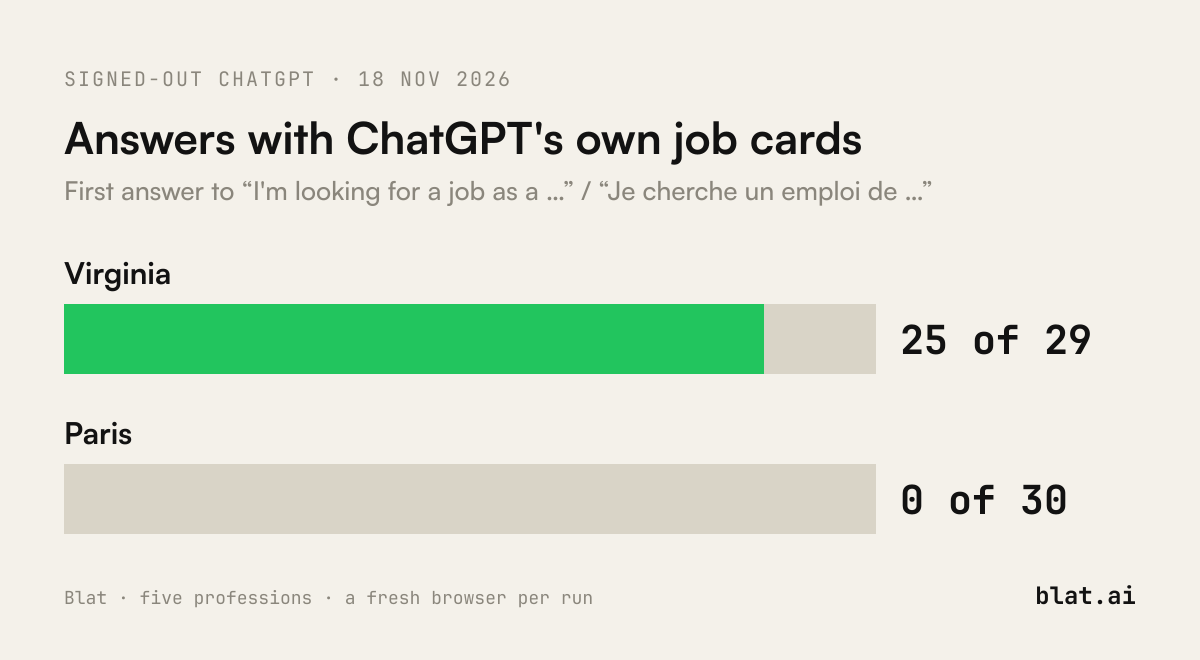
| First answer, signed out | Virginia | Paris |
|---|---|---|
| ChatGPT's own job cards | 25 of 29 | 0 of 30 |
| Searched the web | 29 of 29 | 27 of 30 |
| Suggested a plugin | 0 | 0 |
From Virginia, ChatGPT answered with its own job cards: 128 cards in 25 answers, sourced, as the cards say,
from ZipRecruiter (60), Indeed (42), Appcast (16) and LinkedIn (9). All but one carry an "Apply on …" button that
leaves through a tracking link tagged chatgpt_jobs. This is OpenAI's own job search. Its
release notes of 1 June 2026 say ChatGPT "can
surface live listings and freelance opportunities from sources like Indeed, Upwork, Appcast, and across the web",
and that it is available "to users in the U.S." Signed in, from Virginia, we could see the tool behind the
cards: it pulled 75 candidate jobs, exactly 15 from each of five feeds (Appcast, Indeed, LinkedIn, Upwork and
ZipRecruiter), and showed five. That was with Indeed's and HelloWork's plugins connected: the job search was still
answered from ChatGPT's own feed, not from Indeed's plugin. Built-in first, as rule 1 says.
From Paris, ChatGPT searched the web and listed jobs in its text, with links. Of the 70 jobs it named, only 6 linked to the job ad itself; most links went to boards' search pages. HelloWork was the domain cited most (in 20 of 30 runs), then Indeed's French site (14) and France Travail (7). Without a plugin, French boards were still in the answer, through the web.
Rule 2: a connected plugin gets named, sometimes used
Signed in, we connected Indeed's and HelloWork's plugins and asked again.
- Named only when connected. Asked "Do you recommend me to use some plugins?" from Virginia with both connected, ChatGPT put "Indeed — Job searching" first. With nothing connected, it recommended Notion, Gmail and Google Calendar, and didn't name Indeed. In France, with both connected: "On peut déjà utiliser Indeed et Hellowork directement dans cette conversation pour chercher des offres."
- Used sometimes. Asked for a job in France with both connected, ChatGPT searched the web and also called
Indeed's plugin on its own in one of two chats (the call failed on authentication); in the other it used web
search only. ChatGPT didn't call HelloWork's plugin on its own. With an
@mention, both plugins answered.
Rule 3: the search that didn't find a job board
From Virginia and signed in, when a candidate asks about plugins, ChatGPT usually searches its catalogue. Signed out, the traffic hides most tool names, but from Virginia the same kind of plugin search showed up as a visible step (e.g. "Searching plugins for job search and interview preparation") in 27 of 29 runs, and once as "Interacted with Plugin Management". ChatGPT then recommended general tools, led by Google Drive (9 runs) and Canva (6). From Paris it never showed a plugin step, and in 19 of 30 answers said you don't need a plugin (e.g. "Vous n'avez pas forcément besoin de plugins"), naming boards as websites instead.
Signed in, we could read the searches and their results. In four chats, ChatGPT searched its catalogue nine times. No result was a job board.
| Chat | Plugins connected | Searches | Results | Job boards |
|---|---|---|---|---|
| France | none | 1 | 17 | 0 |
| France | Indeed, HelloWork | 1 | 42 | 0 |
| Virginia | Indeed, HelloWork | 4 | 127 | 0 |
| Virginia | none | 3 | 24 | 0 |
With nothing connected, one query was "job search employment vacancies careers recruitment LinkedIn Indeed Glassdoor France Travail Apec". It returned 17 plugins, none of them a job board. ChatGPT told the candidate:
"je n'ai pas trouvé de plugin spécialisé et fiable permettant de rechercher directement des offres sur LinkedIn, Indeed ou France Travail dans le catalogue disponible."
And from Virginia, with nothing connected:
"There are job-search integrations in some app directories, but I didn't find a dedicated job-board plugin available in the current search. … ChatGPT can search for current job openings without an extra plugin."
Instead, it offered to connect Notion (nothing connected) or Todoist (with the job plugins on).
Two fair caveats. The search tool's own description says its results "are not exhaustive", and asks ChatGPT to mention that more plugins may be in the plugin directory; none of the answers that came up empty did. And with Indeed connected, a search for exactly "Indeed Job Search" didn't return Indeed: the search may leave out installed plugins, so we don't count it. The four searches with nothing connected are the ones that count.
So, as far as we could see, ChatGPT only brought up a board's plugin in the chat for candidates who had already connected it. Otherwise it said it couldn't find one, and moved on with its own tools.
Our reading: ChatGPT is becoming a job aggregator, in the US
This is our reading, not something we measured. In the US, ChatGPT already acts as a job aggregator: it pulls listings from several feeds, shows them in its own cards and sends the candidate to the source site to apply. Its rulebook tells it to put those built-in tools first, before any one board's plugin.
That's the agent from The Lazy Job Seeker: it "searches ALL the job boards, every day. Not just the ones you know." An assistant that wants every job has little reason to send a candidate into one board's plugin. In France, for now, the same role falls to web search, which in Paris cited the boards' own search pages.
We saw ads on both sides: one of the 59 signed-out chats carried a sponsored card for a résumé service, and in the one chat where we called Indeed's plugin by name, it put sponsored jobs in 3 of its 10 places, including the first two.
What a job board can do
- Be what the built-in tools find. In France, that's web search, which cited boards through their search and listing pages. In the US, it's ChatGPT's job feed, whose partners are named in OpenAI's release note and on the cards.
- Get candidates to connect your plugin. Under rule 2, a connected plugin gets named and, sometimes, used. Under rule 3, ChatGPT didn't bring one up in our tests.
We haven't measured how much traffic any of this moves, or how often candidates connect a board's plugin on their own.
Disclosure. Blat collects public job postings from job boards and sells competitive intelligence and job data to job boards.
Method
- The rules: ChatGPT's Plugin Management skill, read in full on 18 November 2026 in the answer stream of the signed-in chats, and in the mobile app (side bar → Explore → Plugins → Plugin Management) on 19 November. Plugin record by OpenAI, installed by default (listed in the account's installed plugins, also on the web), created 13 August 2026, version 0.1.0. OpenAI can change it at any time.
- Signed out (59 runs): 18 November 2026, 10:10–10:53 UTC, a fresh browser with no account for each run. Two questions per run: "I'm looking for a job as a …" / "Je cherche un emploi de …", then "Do you recommend me to use some plugins?" / "Tu me recommandes d'utiliser des plugins ?". Software engineer 10 times from each place; nurse, warehouse operative, sales representative and accountant 5 times each (sales 4 times from Virginia). The signed-out traffic hides most tool names: plugin steps are read from their visible labels.
- Where: US runs were made from Virginia, French runs from France (signed out, from Paris). ChatGPT localises its answers to the user's location, so results are for those places.
- Signed in: 18 November 2026, one Free account with Memory off, one profession (software engineer). Five chats: two with no plugin connected, three with Indeed's and HelloWork's plugins connected.
- Signed-in results describe single chats, not rates.
- Coding: structure (job cards, searches, links) read from the network traffic; judgement calls (does it list jobs, does it recommend a plugin) coded by an AI model, checked against screenshots on three pilot runs.