 Arnau Pont · Co-founder

The EU Pay Transparency Directive
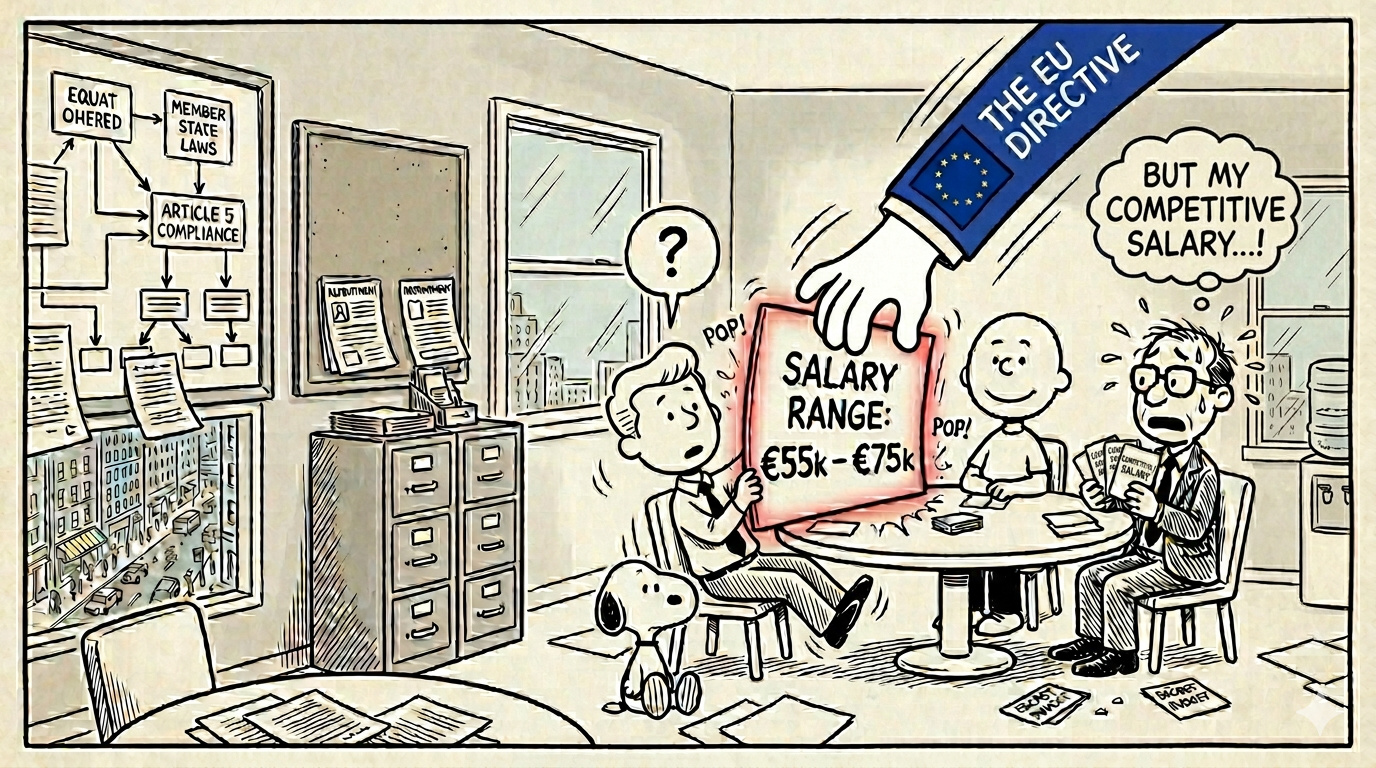
By June 7, 2026, EU member states must implement Directive 2023/970 . Among other things, it requires employers to disclose salary ranges to candidates before the interview. Many might choose to do so directly in the job posting, which affects how job boards collect and display data. Here is what changes and what it means for job boards.
The Directive and the Deadline
The European Union adopted the Pay Transparency Directive (2023/970) on 10 May 2023. Its purpose is to ensure the principle of equal pay for equal or equivalent work between men and women. The directive introduces minimum standards and transparency requirements across the entire employment lifecycle, from the job posting to the pay review.
EU member states have until 7 June 2026 to transpose the directive into national law. Some countries are lagging. The Netherlands initially announced a delay to January 2027, but the European Commission responded that the deadline cannot be extended. The reporting requirements will apply for 2026 regardless. For job boards and employers operating across multiple EU countries, this creates a patchwork of implementation timelines, but the directive sets the floor.
Article 5: Salary in the Job Posting
Article 5 is the part of the directive that directly affects how job boards operate. It introduces three requirements for employers when advertising a position:
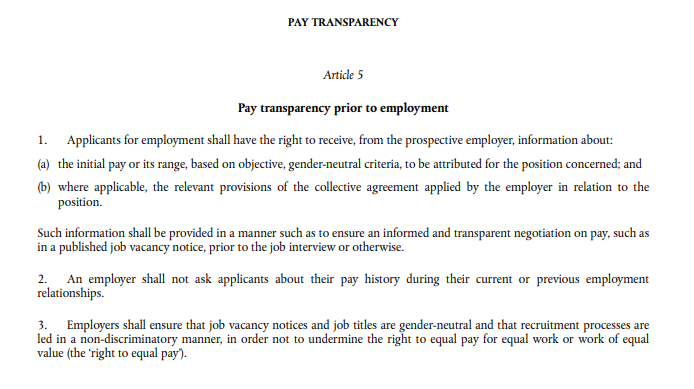
Article 5 requirements:
- 1.The initial pay or pay range must be disclosed in the job posting or before the interview. Not "competitive salary." Not "depending on experience." An actual number or range, based on objective, gender-neutral criteria.
- 2.Employers cannot ask candidates about their salary history from current or previous employment. The negotiation starts from the posted range, not from what the candidate earned before.
- 3.Job titles and vacancy notices must be gender-neutral and non-discriminatory, in order not to undermine the right to equal pay for equal work.
For job boards and ATS platforms operating in the European Union, this means helping employers comply. Boards can assist by recommending salary ranges based on market data and validating that pay information is included before a job goes live. This is especially important when listings are aggregated or scraped from other sources, where salary data may be missing from the original posting.
Beyond Job Postings
The directive goes further than job postings. Employers with 100 or more employees must publish information about the pay gap between male and female staff. If that gap exceeds 5% and cannot be justified, the employer must conduct a joint pay review with employee representatives. Employees who have been harmed by pay discrimination will be entitled to compensation, and the burden of proof rests on the employer.
The Data Problem for Job Boards
Today, most job postings across Europe do not include structured salary data. Some platforms collect it more consistently than others. Indeed, for example, provides salary fields in its schema. LinkedIn often does not. Local boards vary widely.
When the directive takes effect, employers will need to disclose a salary range to candidates. Those who do not comply risk legal consequences. Job boards that cannot display this information will be at a disadvantage. The boards that solve this first could gain a real advantage: candidates will prefer platforms where they can see what the job pays, and employers who comply early signal transparency.
This is already happening. At RecBuzz 2026 in Budapest, we saw how Hellowork, one of the fastest-growing job boards in Europe, was already encouraging employers to include salary information in their postings. Their argument: it makes the job offer more attractive to candidates, helps attract better talent, and closes positions faster. The directive will make this the norm, not the exception.
Salary data exists, but it is scattered across sources. One platform has it for some jobs, another has it for others. The same role posted on two boards might show a salary on one and nothing on the other. Aggregating job postings across multiple sources and matching them can help fill these gaps. This is not just a compliance exercise. It is a data infrastructure problem.
Beyond Compliance
There is also a business case. When salary information is visible, candidates can make more informed career decisions. Employees who discover their pay is below market are more likely to explore new opportunities. More movement in the labor market means more activity on job boards. For platforms that embrace transparency early, the directive is not just a compliance cost. It is a growth driver.
That said, this effect may not last forever. Once the market readjusts and salary inequalities narrow, the initial wave of movement could slow down. A more transparent market is also a more predictable one, and that could make the job seeking market more rigid over time. The short-term opportunity is real, but the long-term landscape will look different.