The Hiring Journey
This is a framework we built for ourselves to make sense of the recruitment tech landscape, and we are sharing it because we think others will find it useful. It is intentionally basic.
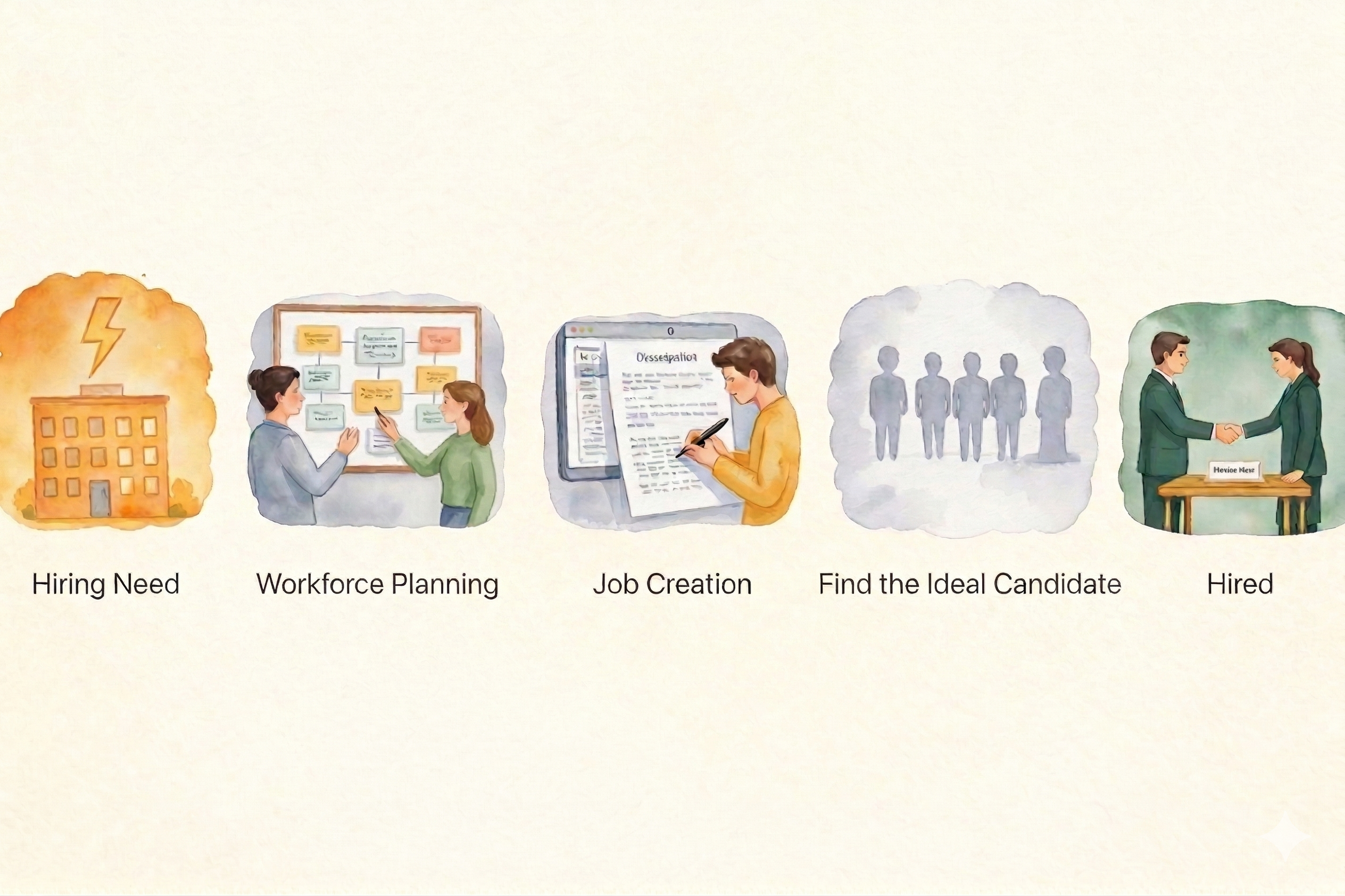
Recruitment technology might change every year, but the underlying process has never changed. Every hire, from a junior role to a CEO, follows the same three stages. Any tool, old or new, can be explained and placed somewhere in this hiring journey. It all starts with an event. Something happens inside a company that sets the hiring process in motion. We call it the Hiring Need.
Hiring Need
Something happens that creates a need to hire. A company wins a public tender and needs a team to deliver. A key employee leaves. Revenue grows and the current team can't keep up. A new office opens in another country. The trigger can be planned or unexpected, but it always starts here.
3 Stages
Workforce Planning
Before writing a single job description, someone needs to define what roles are needed, which skills matter, and how new hires fit the team structure. For a single hire this might be a five-minute conversation. For scaling a team across multiple locations, it becomes a strategic exercise that shapes the quality of every hire downstream.
Job Creation
The role is defined and the job description is written. This step matters more than most people think. A well-crafted job description attracts the right candidates and filters out the wrong ones before they even apply. A bad one wastes everyone's time.
Find the Ideal Candidate
The job exists. Now someone needs to fill it. This is where the real work begins: getting the right person to see the opportunity, evaluating them, and closing the hire. How you do this depends on the approach you choose.
Hired
The candidate accepts the offer and joins the team. The journey is complete. But how do you know if it worked?
Two Approaches
Stage 3, Find the Ideal Candidate, can be executed in fundamentally different ways. Both are valid. Both have trade-offs. Most companies use a mix depending on the role.
Attract
They come to you
You publish the job and make it visible. Candidates find it, apply, and you screen them. The more places you publish, the larger the pool. The larger the pool, the higher the odds of finding the right person. But also the more noise you have to filter.
Source
You go to them
You identify specific people and reach out to them directly. They may not be looking for a job. The pool is smaller but more targeted. The quality tends to be higher, but the cost and effort per candidate is significantly greater.
Regardless of the approach, once candidates are in the pipeline, what follows is similar: screening, interviewing, evaluating, and deciding. These steps are part of Stage 3 as well. The approach determines how candidates enter the process. The screening and selection determine who comes out.
Two Metrics That Matter
Every tool, every approach, every decision in the hiring journey ultimately moves one or both of these numbers.
Days from need identified to offer accepted. Every stage either accelerates or slows this down.
How well the hired person fits the role, culture, and expectations. A larger candidate pool and better screening both raise quality.
It would be interesting to know how often companies involved in finding the ideal candidate follow up after the hire. Do they check in with the employer after 3, 6, or 12 months? Some probably do. If these are the two numbers that matter, it makes sense for every tool in the hiring journey to show how it moves them. Time to Hire and Quality of Hire on the landing page of every job board, every ATS, every recruitment agency. There are many ways to measure this, and new technologies are opening up even more possibilities. For these numbers to be credible, having an independent third party in charge of calculating and verifying them would make a real difference.
Conclusion
The hiring journey is simple: a need appears, a company plans, creates a role, and finds the right person. What changes is how each step is executed. Job boards, headhunters, AI agents, programmatic advertising, they all sit somewhere in this framework. The tools will keep evolving. The journey will not. Understanding where each tool fits, and measuring its impact on Time to Hire and Quality of Hire, is the starting point for making better decisions about which ones to use.